1. Introduction to NextGen Academy PWD
In an increasingly digital world, professional success depends on more than academic qualifications alone. Practical abilities, technological literacy, creative problem-solving, and effective communication have become important components of career development. For students, aspiring freelancers, entrepreneurs, and professionals seeking new opportunities, acquiring relevant digital skills can be a valuable investment.
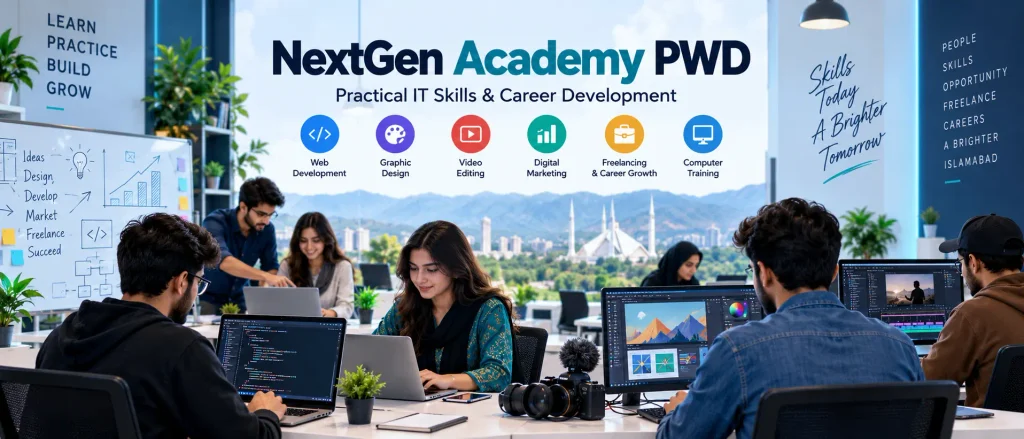
NextGen Academy PWD is an IT and vocational training initiative associated with PWD, Islamabad, Pakistan. Its publicly available profile highlights courses and training areas such as web development, graphic designing, video editing, digital marketing, basic computer skills, and English proficiency. Its stated location is on Main PWD Road, near Virtual University, Islamabad.
The academy’s relevance lies in its focus on skills that can be applied to practical tasks, digital projects, and professional development. Rather than viewing technology merely as a theoretical subject, learners can explore how digital tools support website creation, business promotion, visual communication, and online work.
For prospective students, the most important consideration is finding a learning pathway that matches their current abilities, interests, and long-term objectives.
2. Understanding the Importance of Digital Skills
Digital skills have become integral to education, commerce, communication, and entrepreneurship. Businesses rely on websites, online advertising, digital payment systems, social media, and data-driven decision-making to connect with customers and manage daily operations.
This transformation has created opportunities for people who understand how to use technology effectively. A small business owner may need a website to display products, while a content creator might require video-editing skills to produce engaging material. Similarly, a job seeker may benefit from computer proficiency, professional communication, and familiarity with digital tools.
Learning these abilities can improve employability and expand professional options. However, acquiring a skill does not automatically guarantee employment or income. Consistent practice, demonstrable competence, market awareness, and professional reliability remain essential.
3. What Makes NextGen Academy PWD Relevant to Modern Learners?
A useful training programme should connect learning with real-world applications. NextGen Academy PWD publicly promotes skill-based courses intended to introduce learners to practical areas of information technology and digital work.
The relevance of such training depends on how effectively students can translate lessons into tangible outcomes.
For example, a web development learner should ideally understand how to structure a website, arrange its visual elements, and make it usable on different screen sizes. A graphic design student should be able to create visual material that communicates a clear message. Someone studying digital marketing should learn to plan campaigns, identify audiences, and evaluate performance.
These competencies provide a foundation for further development. Prospective students should nevertheless confirm the current curriculum, practical exercises, instructor experience, and assessment methods before enrolling.
4. Location and Accessibility in PWD Islamabad
Location can influence the convenience of attending a training programme, particularly for students balancing education, employment, and family responsibilities.
Public information associated with NextGen Academy PWD identifies its location as Main PWD Road, near Virtual University, Islamabad.
PWD provides a familiar reference point for residents of Islamabad and nearby Rawalpindi communities. Before visiting, prospective students should confirm the academy’s current premises, class timings, transport arrangements, and admission availability.
It is also useful to ask whether classes are conducted in person, online, or through a hybrid arrangement. These details can help learners choose a schedule that accommodates their existing commitments.
5. Web Development: Building a Digital Future
Web development involves creating and maintaining websites and web-based applications. It combines technical knowledge, logical reasoning, visual organisation, and an understanding of how users interact with digital interfaces.
For beginners, it can be an appealing starting point because progress is often visible. A simple webpage can gradually evolve into a structured website containing multiple pages, interactive elements, and functional features.
Understanding Website Design and Development
Most introductory web development pathways begin with HTML, CSS, and JavaScript.
- HTML establishes the structure and content of a webpage.
- CSS controls presentation, including colours, spacing, typography, and responsive layouts.
- JavaScript adds interactive behaviour, such as menus, form validation, and dynamic content.
As learners progress, they may explore content management systems, databases, server-side programming, and website deployment, depending on the course syllabus.
A good learning experience should connect these concepts rather than teach them as isolated technical definitions. Building a personal portfolio, a small business website, or a landing page can help students understand how individual components work together.
Practical Projects and Portfolio Development
Projects transform abstract knowledge into demonstrable competence.
A beginner might develop a personal profile website, a product catalogue, or a basic business landing page. Each project presents opportunities to practise layout design, accessibility, content organisation, and troubleshooting.
A portfolio should explain what the learner created, which tools were used, and what problem the project addresses. Even a modest project can demonstrate initiative when it is functional, well organised, and clearly presented.
6. Graphic Designing and Video Editing
Visual communication plays a central role in modern business. Companies use graphics, promotional videos, product imagery, and branded content to communicate their identity and attract audiences.
Graphic designing and video editing offer complementary creative capabilities. Design communicates through composition, typography, colour, and imagery, while editing shapes recorded footage into a coherent visual narrative.
Visual Communication and Creative Thinking
Graphic design extends beyond making images attractive. Effective design helps an audience understand information quickly and remember a message.
Learners can begin by studying visual hierarchy, contrast, alignment, spacing, colour relationships, and typography. These principles apply to social media posts, brochures, advertisements, presentations, and brand identities.
Practical exercises might include designing a promotional poster, creating a consistent set of social media graphics, or developing a simple brand identity for a fictional business.
Students should also learn to distinguish original work from copied material and understand the licensing conditions attached to photographs, fonts, illustrations, and other creative assets.
Video Editing for Digital Platforms
Video editing combines technical precision with storytelling. Editors select footage, organise scenes, improve pacing, synchronise audio, add transitions, and refine the final presentation.
Short-form videos require particular attention to the opening seconds, clarity, rhythm, and mobile viewing. Longer educational videos demand coherent sequencing, useful explanations, and sustained audience engagement.
A practical portfolio might include a short promotional video, an educational explainer, and a product presentation. These examples can demonstrate versatility without requiring expensive equipment at the beginning.
7. Digital Marketing: Reaching the Right Audience
Digital marketing involves promoting products, services, organisations, and ideas through online channels. It draws on creativity, communication, audience research, and performance measurement.
NextGen Academy PWD has publicly advertised a digital marketing course and described practical training and a freelancing component in its promotional material. The published offer should be reconfirmed because course availability and fees can change.
Search Engine Optimization and Content Strategy
Search engine optimization, commonly called SEO, focuses on improving the visibility and usefulness of website content in organic search results.
Important introductory concepts include keyword research, search intent, page titles, headings, internal linking, content quality, and technical accessibility.
Effective SEO is not simply a matter of repeating a phrase many times. Content should answer genuine questions, provide accurate information, and organise ideas in a way that helps readers.
For example, a local training academy might publish a useful guide explaining how beginners can choose an IT course in Islamabad. If the article is informative, relevant, and technically accessible, it may support the website’s visibility over time. Rankings, however, cannot be guaranteed.
Social Media Marketing and Online Advertising
Social media marketing involves planning content, understanding audiences, maintaining brand consistency, and evaluating engagement across digital platforms.
Students can practise preparing content calendars, writing captions, creating promotional graphics, and reviewing metrics such as reach, clicks, conversions, and audience retention.
Paid advertising introduces additional considerations, including campaign objectives, audience selection, budgets, creative testing, and platform policies.
A responsible marketer must also respect consumer privacy, intellectual property, and advertising requirements. Sustainable marketing is built on trust and measurable value rather than exaggerated claims.
8. Basic Computer Skills for Everyday Professional Work
Basic computer proficiency remains important even as specialised technologies become more sophisticated.
Learners may need to understand file management, document creation, spreadsheets, presentations, email communication, internet research, and online collaboration. These abilities support academic assignments, administrative responsibilities, and business operations.
Practical exercises are especially useful. Creating a properly formatted document, organising folders, preparing a spreadsheet, and sending a professional email can build confidence through repeated application.
Digital safety should be included as well. Students should understand strong passwords, multifactor authentication, software updates, suspicious links, and the importance of protecting confidential information.
These foundational competencies make it easier to approach advanced technical subjects later.
9. English Proficiency and Workplace Communication
Technical knowledge becomes more useful when it can be communicated clearly. English proficiency can help learners understand software documentation, participate in international projects, communicate with clients, and prepare professional applications.
Effective communication does not require unnecessarily complicated vocabulary. It requires clarity, appropriate tone, logical organisation, and an ability to understand the audience.
Learners can practise writing professional emails, introducing themselves, explaining a project, asking relevant questions, and discussing deadlines.
Speaking exercises can also build confidence. Describing a website, presenting a design concept, or explaining a marketing campaign encourages students to connect technical knowledge with professional expression.
The objective should be functional communication rather than perfection. Regular practice and constructive feedback are more useful than memorising long lists of unfamiliar words.
10. Cybersecurity and Responsible Digital Practices
As more activities move online, understanding cybersecurity has become increasingly valuable. Digital safety concerns individuals, educational institutions, businesses, and government organisations alike.
NextGen Academy PWD has also appeared in public promotional material for a beginner-oriented cybersecurity course, describing areas such as networking fundamentals, security concepts, introductory ethical hacking, and practical exercises. Interested learners should confirm whether this course is currently offered.
Cybersecurity education can introduce learners to common threats, including phishing, malware, weak authentication, and unauthorised access.
Ethical conduct is fundamental. Security testing should be performed only on systems for which appropriate permission has been granted. Curiosity about technology must never become an excuse to access private accounts, disrupt networks, or misuse personal data.
For beginners, a sound foundation in computer systems, networking, safe browsing, and responsible disclosure provides a sensible starting point.
11. E-Commerce, Amazon Wholesale, and Private Label
E-commerce allows businesses to sell products through digital platforms, while online marketplaces provide infrastructure for product discovery, purchasing, and customer communication.
NextGen Academy PWD’s public profile lists Amazon wholesale and private label among its areas of specialisation.
These business models have different requirements.
Wholesale generally involves purchasing existing branded products for resale, subject to supplier agreements, marketplace rules, and applicable legal requirements.
Private label typically involves selling products under a seller’s own brand, often requiring product research, supplier coordination, packaging decisions, quality control, and brand development.
Both approaches demand commercial judgement. Learners should understand product costs, shipping, platform fees, returns, inventory risks, and customer service before investing money.
A course may introduce the underlying processes, but it should not be treated as a guarantee of profitable sales. Marketplace policies and commercial conditions can change, making continued research essential.
12. Freelancing: Turning Skills into Professional Services
Freelancing allows individuals to provide services to clients without necessarily working as permanent employees of a single organisation.
Web development, graphic design, video editing, and digital marketing are examples of services that may be delivered remotely. However, successful freelancing requires more than technical ability.
Professionals must identify suitable clients, understand project requirements, prepare realistic quotations, communicate progress, meet deadlines, and manage revisions.
Beginners can start by selecting one core service and building a small portfolio of relevant projects. A designer might specialise initially in social media graphics, while a web developer might focus on simple business websites.
It is sensible to establish clear deliverables, payment terms, revision limits, and communication expectations before beginning paid work.
Freelancing can provide flexibility, but income may fluctuate. Developing a reliable reputation usually takes time, persistence, and consistent delivery.
13. Practical Learning Versus Traditional Theory
Theory explains concepts. Practice reveals how those concepts behave under real conditions.
Both are necessary. Students who memorise terminology without applying it may struggle when faced with unfamiliar problems. Conversely, learners who rely exclusively on imitation may find it difficult to adapt when a tool or workflow changes.
A balanced training approach introduces a concept, demonstrates its use, allows students to practise, and provides feedback on the result.
For example, a digital marketing lesson could begin with audience research, proceed to campaign planning, and conclude with an exercise evaluating hypothetical performance data.
A web development lesson could involve building a page, identifying errors, and improving its usability.
Prospective students should ask whether the academy provides practical assignments, instructor feedback, project reviews, and opportunities to demonstrate independent work.
14. Who Can Benefit from NextGen Academy PWD?
A practical IT training programme may suit learners with different educational and professional backgrounds.
- Students: Those interested in exploring technology alongside their academic studies.
- Recent graduates: Individuals seeking to develop complementary professional skills.
- Working professionals: People who want to broaden their capabilities or explore a career transition.
- Entrepreneurs: Business owners who want to understand digital promotion, website management, or online commerce.
- Creative beginners: Individuals interested in graphic design, visual storytelling, and video production.
- Aspiring freelancers: People preparing to offer digital services to potential clients.
Prior experience may not be necessary for every introductory course, but admission requirements vary by subject.
Before enrolling, students should confirm the expected entry level, required equipment, language of instruction, and amount of time needed for independent practice.
15. Career Opportunities After Learning Digital Skills
Digital training can help learners explore several professional pathways, depending on the depth of their knowledge and the quality of their work.
| Skill area | Potential entry-level direction |
|---|---|
| Web development | Junior web developer or website assistant |
| Graphic design | Junior graphic designer or design freelancer |
| Video editing | Video editor or content production assistant |
| Digital marketing | Marketing assistant or social media coordinator |
| Computer skills | Administrative or computer-support roles |
| E-commerce | Marketplace assistant or e-commerce support |
| Cybersecurity | Further study towards entry-level security roles |
These are illustrative possibilities, not guaranteed outcomes of completing a course.
Employers and clients generally assess practical competence, communication, reliability, and relevant experience. Some positions also require formal qualifications or more advanced technical knowledge.
A training course is best understood as a starting point. Continued learning and evidence of ability help turn that foundation into professional progress.
16. Building a Strong Portfolio and Professional Profile
A portfolio provides evidence of what a learner can actually do. It is often more persuasive than a list of software names or course certificates alone.
A beginner’s portfolio does not need dozens of projects. Three to five carefully completed examples can be a useful starting point.
Each example should explain the objective, the learner’s contribution, the tools used, and the final outcome. Where appropriate, screenshots, live links, short demonstrations, or before-and-after comparisons can make the work easier to evaluate.
Students should identify personal projects honestly and never present another person’s work as their own.
Professional profiles can also include a concise biography, relevant skills, project descriptions, and contact information. Consistency across portfolios, CVs, and professional networking accounts creates a clearer impression of the learner’s capabilities.
17. How to Choose the Right Course
Selecting a course requires more than choosing the subject with the most attractive promotional message.
First, identify the intended outcome. Someone who enjoys visual storytelling may prefer graphic design or video editing, while a learner interested in technical problem-solving may gravitate towards web development or cybersecurity.
Second, evaluate the syllabus. Does it begin with the necessary foundations? Does it cover practical applications? Are there opportunities to complete projects?
Third, assess the learning arrangements. Ask about instructor qualifications, class size, teaching methods, feedback, and access to learning materials.
Finally, compare the course commitment with your available time and budget.
A short introductory programme may be appropriate for exploration, whereas more advanced objectives can require sustained study and substantial independent practice.
The right choice is the course that aligns with the learner’s goals and provides a realistic route towards measurable progress.
18. Course Duration, Fees, and Admission Enquiries
Course fees, schedules, admission requirements, and programme availability are important considerations for prospective students.
Public promotional material from NextGen Academy PWD previously advertised a three-month digital marketing course for PKR 30,000, including a freelancing course. This is a previously published offer, not a verified current price.
Before making a financial commitment, students should request current written details covering:

- Total course fee and any additional charges.
- Start date, duration, and weekly class schedule.
- Course syllabus and practical project requirements.
- Whether software, equipment, and learning materials are included.
- Attendance requirements and assessment methods.
- Certificate eligibility and the issuing organisation.
- Refund, withdrawal, and rescheduling policies.
For enquiries, the academy’s publicly listed contact number is 0314-8486520. Its published location is Main PWD Road, near Virtual University, Islamabad. Contact details and premises should be confirmed before visiting or paying any fees.
Clear communication before enrolment helps learners make informed decisions and avoid misunderstandings.
19. The Role of Mentorship and Continuous Learning
Technology evolves rapidly. Software interfaces change, new tools emerge, and professional expectations develop alongside industry practices.
For this reason, learning should not end when a course finishes.
Mentorship can help beginners identify mistakes, prioritise important concepts, and receive feedback that would be difficult to obtain through independent study alone. A supportive instructor can also help students develop problem-solving habits rather than relying entirely on step-by-step demonstrations.
However, students should actively participate in the process. Asking questions, documenting errors, reviewing feedback, and completing independent projects are essential habits.
Continuous learning may involve reading documentation, following reputable educational resources, practising new workflows, and studying developments relevant to a chosen field.
The objective is not to master every available tool. It is to develop adaptable skills and the judgement to select appropriate tools for specific problems.
20. Common Mistakes Beginners Should Avoid
New learners often approach digital education with considerable enthusiasm, but a few avoidable mistakes can slow their progress.
Expecting immediate earnings: Technical competence and client trust take time to develop. Income is uncertain, particularly at the beginning.
Learning too many skills simultaneously: Exploring several subjects can be useful initially, but focusing on one primary skill often makes it easier to build demonstrable expertise.
Collecting certificates without projects: Certificates may document participation or completion, but practical work provides additional evidence of capability.
Ignoring communication: Missed deadlines, vague messages, and unclear expectations can damage professional relationships even when technical work is strong.
Copying without understanding: Reproducing templates can be useful practice, but learners should understand the principles behind their work and gradually develop independent solutions.
Neglecting ethical practices: Plagiarism, unauthorised access, misleading marketing claims, and misuse of customer information can have serious consequences.
Progress is usually more sustainable when learners establish realistic goals, practise consistently, and evaluate their work critically.
21. How to Prepare Before Joining an IT Course
A little preparation can make the learning experience more productive.
Begin by defining a specific objective. For example, aim to build a basic website, design a portfolio of promotional graphics, or understand the fundamentals of social media marketing.
Next, assess your current knowledge. Identify whether you are completely new to the subject or already familiar with its basic concepts.
Check the technical requirements, including computer specifications, internet access, software subscriptions, and any materials you may need. Do not purchase expensive equipment or software before confirming the actual requirements.
It is also helpful to allocate regular practice time outside the classroom. Even short, consistent sessions can reinforce new concepts.
Finally, prepare questions for the admissions team. Understanding the syllabus, assessment process, and expected outcomes will help you approach the course with a clearer sense of direction.
22. Evaluating Training Quality and Student Support
The quality of an educational programme cannot be established solely through its promotional claims. Prospective students should look for concrete indicators of effective teaching.
A well-organised programme typically has a clear syllabus, defined learning objectives, appropriate exercises, constructive feedback, and transparent assessment criteria.
Practical projects are especially useful because they reveal whether learners can apply concepts independently. Students should also understand how instructors respond to questions and what support is available when they encounter difficulties.
Where possible, prospective learners can request a sample lesson, review examples of student work shared with permission, or speak with former students.
Claims about employment, income, professional certification, or guaranteed outcomes should be examined carefully. Any certification should be checked with the organisation responsible for issuing or recognising it.
These steps allow students to evaluate the training on evidence rather than assumptions.
23. The Future of Digital Skills in Pakistan
Pakistan’s digital economy offers opportunities across software development, creative services, online commerce, marketing, and remote professional work. These areas also present challenges, including competition, uneven access to resources, and the need for continuing technical education.
For aspiring professionals, the most useful response is to develop skills that solve identifiable problems.
A business may need a faster, more accessible website. A content creator may need polished video production. A retailer may require better product listings and customer communication. Each need represents a potential application for practical digital knowledge.
Training institutions can contribute by helping learners develop foundational competence, complete meaningful projects, and understand professional expectations.
For learners in Islamabad and Rawalpindi, an accessible local training option may provide a convenient starting point. Its ultimate value, however, depends on the quality of instruction, the student’s commitment, and the relevance of the skills acquired.
The long-term objective should be capability, not merely course completion.
24. Frequently Asked Questions About NextGen Academy PWD
What is NextGen Academy PWD?
NextGen Academy PWD is an IT and vocational training initiative in PWD, Islamabad, that publicly promotes digital and professional skills courses.
Which courses are associated with NextGen Academy PWD?
Its public profile lists web development, graphic designing and video editing, digital marketing, basic computer skills, English proficiency, Amazon wholesale, and private label. Public promotional material has also described cybersecurity training. Current availability should be confirmed directly.
+1
Where is NextGen Academy PWD located?
Its published location is Main PWD Road, near Virtual University, Islamabad. Confirm the current premises before travelling.
How can prospective students contact the academy?
The publicly listed contact number is 0314-8486520. Contact the academy to verify current admission arrangements, course details, and fees.
Is NextGen Academy PWD suitable for beginners?
Its public promotional material includes beginner-oriented and foundational training areas. Suitability depends on the specific course, entry requirements, and the learner’s existing knowledge. Ask for the current syllabus before enrolling.
Can learning digital skills help someone start freelancing?
Yes. Skills such as web development, graphic design, video editing, and digital marketing can form the basis of freelance services. However, earning income also requires practical competence, client communication, portfolio development, and consistent delivery.
Does completing a course guarantee a job or online income?
No course should be assumed to guarantee employment or earnings without verifiable terms and evidence. Career outcomes depend on multiple factors, including individual performance, market conditions, and relevant experience.
How should someone choose the best course?
Start with a clear career objective, compare syllabuses, assess practical training opportunities, confirm fees and schedules, and evaluate the quality of instruction before making a decision.
25. Conclusion: Taking the First Step Towards Digital Growth
Digital skills can open pathways to creative work, technical careers, entrepreneurship, and online professional services. Yet meaningful progress requires more than exposure to software or completion of a training programme. It depends on practice, critical thinking, professional discipline, and the ability to apply knowledge to real problems.
NextGen Academy PWD presents a local option for people interested in exploring IT and vocational training in Islamabad. Its publicly listed subject areas span web development, graphic design, video editing, digital marketing, computer fundamentals, and other digital business skills.
For prospective students, the best next step is straightforward: identify a goal, review the current syllabus, verify the training arrangements, and choose a programme that fits both personal ambitions and available resources.
A skill becomes valuable when knowledge turns into capability, and capability turns into work that solves a real problem.